
About the Journal
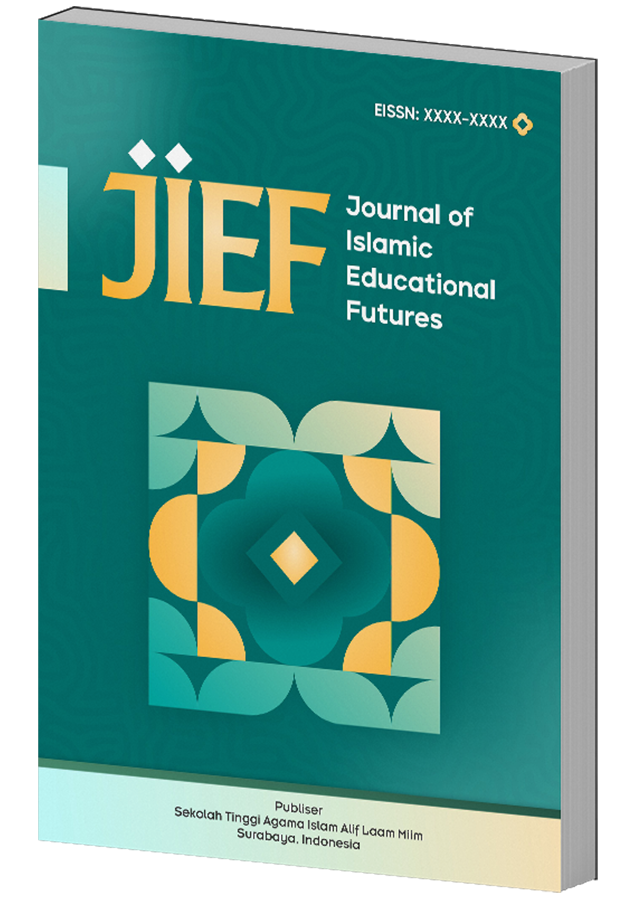
Journal of Islamic Educational Futures (JIEF) is an international peer-reviewed journal published and managed by LPPM STAI Alif Lam Miim Surabaya, first established in 2026. The journal is published twice a year, with issues released in February and August, and is available as an online journal. JIEF applies a double-blind peer-review process, in which submitted manuscripts are independently evaluated by qualified reviewers whose identities are concealed from the authors, while the identities of authors are also concealed from reviewers. This process is implemented to ensure the quality, originality, academic rigor, and relevance of published manuscripts. JIEF publishes high-quality original research, theoretical studies, systematic literature reviews, and scholarly discussions addressing the development, transformation, and future directions of Islamic education.
JIEF provides an academic platform for researchers, educators, policymakers, and practitioners to explore innovative ideas, emerging trends, and transformative practices responding to the challenges and opportunities of Islamic education in the twenty-first century. The journal emphasizes interdisciplinary perspectives that integrate Islamic educational values with contemporary scientific, technological, social, cultural, and global developments. All topics published in JIEF are expected to demonstrate a clear and substantive connection to the development, transformation, sustainability, or future of Islamic education, including studies addressing technology, artificial intelligence, innovation, educational leadership, inclusion, sustainability, and educational policy.
The journal welcomes manuscripts covering Islamic education, curriculum and pedagogical innovation, educational technology, artificial intelligence in education, digital learning, educational leadership and management, teacher professional development, learning innovation, assessment, character and values education, inclusive education, multicultural education, environmental and sustainability education, higher education, educational policy, and the integration of Islamic and contemporary sciences. Manuscripts addressing these themes are particularly encouraged when they examine their implications for strengthening Islamic educational theory, practice, institutions, policies, or future educational systems. Studies employing qualitative, quantitative, mixed-methods, case study, action research, and systematic literature review approaches are welcomed.
JIEF particularly prioritizes manuscripts that offer significant theoretical contributions, empirical findings, and practical or policy implications for advancing Islamic education in local, national, and global contexts. By fostering interdisciplinary scholarly dialogue, the journal seeks to contribute to the development of future-oriented Islamic educational systems that are innovative, inclusive, sustainable, ethically grounded, and responsive to rapid social, cultural, technological, and educational transformation.
Current Issue
Articles
| Jurnal title | Journal of Islamic Educational Futures |
| Subtitle | JIEF |
| APC | Free |
| Frequency | 2 issues per year (August and February) |
| DOI | https://doi.org/10. |
| Online ISSN | 3164-1172 |
| Language | English |
| Editor In Chief | Moh Takwil, STAI Alif Lam Miim Surabaya, Indonesia (Sinta ID: 6794149) |
| Publisher | LPPM Sekolah Tinggi Agama Islam Alif Laam Miim Surabaya |
| Citation Analysis | Google Scholar. Dimension, Garuda, Crossref |
Journal of Islamic Educational Futures (JIEF) is an international peer-reviewed journal published and managed by LPPM STAI Alif Lam Miim Surabaya, first established in 2026. The journal is published twice a year, with issues released in February and August, and is available as an online journal. JIEF applies a double-blind peer-review process, in which submitted manuscripts are independently evaluated by qualified reviewers whose identities are concealed from the authors, while the identities of authors are also concealed from reviewers. This process is implemented to ensure the quality, originality, academic rigor, and relevance of published manuscripts. JIEF publishes high-quality original research, theoretical studies, systematic literature reviews, and scholarly discussions addressing the development, transformation, and future directions of Islamic education.
JIEF provides an academic platform for researchers, educators, policymakers, and practitioners to explore innovative ideas, emerging trends, and transformative practices responding to the challenges and opportunities of Islamic education in the twenty-first century. The journal emphasizes interdisciplinary perspectives that integrate Islamic educational values with contemporary scientific, technological, social, cultural, and global developments. All topics published in JIEF are expected to demonstrate a clear and substantive connection to the development, transformation, sustainability, or future of Islamic education, including studies addressing technology, artificial intelligence, innovation, educational leadership, inclusion, sustainability, and educational policy.
The journal welcomes manuscripts covering Islamic education, curriculum and pedagogical innovation, educational technology, artificial intelligence in education, digital learning, educational leadership and management, teacher professional development, learning innovation, assessment, character and values education, inclusive education, multicultural education, environmental and sustainability education, higher education, educational policy, and the integration of Islamic and contemporary sciences. Manuscripts addressing these themes are particularly encouraged when they examine their implications for strengthening Islamic educational theory, practice, institutions, policies, or future educational systems. Studies employing qualitative, quantitative, mixed-methods, case study, action research, and systematic literature review approaches are welcomed.
JIEF particularly prioritizes manuscripts that offer significant theoretical contributions, empirical findings, and practical or policy implications for advancing Islamic education in local, national, and global contexts. By fostering interdisciplinary scholarly dialogue, the journal seeks to contribute to the development of future-oriented Islamic educational systems that are innovative, inclusive, sustainable, ethically grounded, and responsive to rapid social, cultural, technological, and educational transformation.
 |
 |
 |
 |
|||
 |
 |
 |
||||