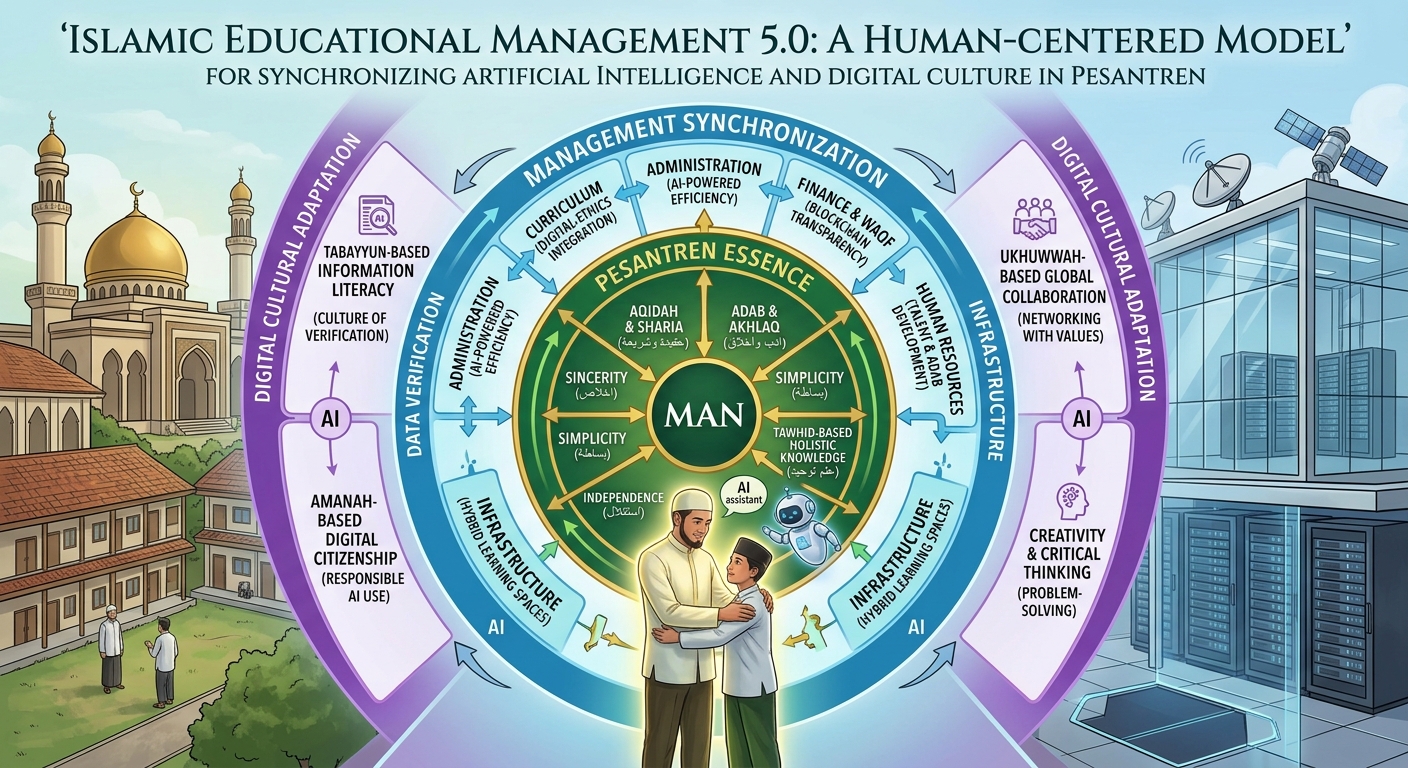
Islamic Educational Management 5.0: A Human-Centered Model for Synchronizing Artificial Intelligence and Digital Culture in Pesantren
Keywords:
Islamic Educational Management 5.0; Artificial Intelligence; Digital CultureAbstract
The emergence of Society 5.0 and Artificial Intelligence (AI) presents opportunities and challenges for traditional Islamic boarding schools (pesantren), requiring technological transformation without compromising spiritual authority and classical scholarship (turats). This study examines the operationalization of Islamic Educational Management 5.0 at Pesantren Nurul Huda, focusing on the synchronization of AI, digital culture, and Islamic governance. Using a qualitative single-case study, data were collected through semi-structured interviews with kiai, asatidz, IT managers, and santri, six-week observations, and institutional document analysis. Data were analyzed using Miles, Huberman, and Saldana’s interactive model, supported by methodological triangulation and member checking. Findings indicate three dimensions of synchronization: AI-supported academic and administrative management, dual-filter cultural adaptation combining technical and Islamic ethical evaluation, and human-centered governance in which AI functions as a decision-support tool (wasilah) under religious leadership. The study proposes a human-centered Islamic Educational Management 5.0 framework that enhances efficiency while preserving sanad al-‘ilm, suhbah, and institutional authenticity.