Sakinah Circle: An Asset-Based Community Engagement Model for Strengthening Muslim Women’s Spiritual Resilience
Keywords:
Social Comparison; Qana'ah; Rida; Spiritual Resilience; Abcd; Digital Well-Being; Muslim WomenAbstract
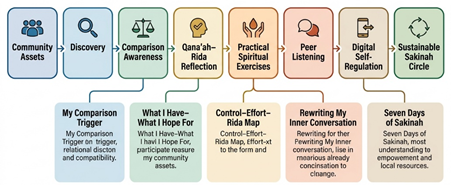
Digital social media increasingly exposes women to selective representations of other people's achievements, lifestyles, appearance, and family conditions, potentially intensifying social comparison and weakening self-evaluation. This community engagement program aimed to strengthen spiritual resilience among women in a Qur'anic study community at Masjid Pusaka, Siman, Ponorogo, Indonesia, by integrating Islamic values with digital self-awareness practices. The program employed an Asset-Based Community Development (ABCD) approach through Discovery, Dream, Design, Delivery, and Sustainability stages. The Sakinah Circle integrated five reflective practices addressing comparison triggers, gratitude, qana'ah, rida, inner dialogue, peer listening, and digital self-regulation. Data were obtained through participant reflections, observations, group discussions, facilitator notes, and pre-post evaluation instruments. The findings indicated increased awareness of social-comparison triggers, more practical understanding of qana'ah and rida, stronger peer listening practices, and greater awareness of digital boundaries. The program demonstrates that existing religious and social assets can be transformed into a sustainable community-based model of reflective spiritual resilience.